
October is Spina Bifida Awareness Month. For those that don’t know, Spina Bifida is the #1 permanently disabling birth defect in the United States. More people are affected by it than muscular dystrophy, multiple sclerosis, and cystic fibrosis *combined*. I was born with it. And so in honor of awareness month, here is a list of SB related facts. Some were posted on my FB last year, some are brand new. Lengthy as this entry is, it is by no means a complete list and if anyone would like me to add anything, please feel free to leave it in the comments section and I will fact-check it then add it. Still, it’s a pretty comprehensive list. Maybe bookmark it and come back and finish the 3 pages later. 😉 As for my credentials to be saying all these things, I’m not a doctor. But I am an almost 40 year old man who has SB, and hydrocephalus and Chiari II among other secondary conditions that accompany SB. And I paid attention to doctors when they said things at the National SB conferences I attended for 9 years in a row. These are nationally renowned experts, in some cases world renowned experts, in SB. For some, their entire careers have been learning more about SB. So as far as I know from personal experience and from all those doctors saying all those things, every SB fact below is valid.
Don’t forget to click on the pictures to enlarge them. And all the links to learn more. As well as reblog, share, reTweet, repost on various social media and get the word out about this post. Let’s spread the word about Spina Bifida!! Pay close attention to #7 on page two. (Keep scrolling until you see the numbered pages, some people have missed that, and thought I only had 6 facts. I’m wordier than that) 😉 So #7 is full of great information for new parents and for anybody who wants to know what the day-to-day is really like for us. Please click on all the links in #7 as well. And #8 is also pretty important in terms of educating able-bodied folks on something that is key when thinking of the way you see/interact with people with disabilities. Please click those important links also. And #21. Stop sharing that meme. Pretty please 🙂
Happy reading 🙂

Hi Milo! 🙂
1. Spina Bifida (which means “split spine” in Latin) is a developmental birth defect often referred to as a “neural tube” defect. The neural tube is what eventually becomes the spine and brain. This defect, which usually happens in the first 30 days of pregnancy, before a woman even knows she is pregnant, entails the incomplete closure of the embryonic neural tube. What results at birth is that some vertebrae overlying the spinal cord are not fully formed and remain open. In the most common form of Spina Bifida called myelomeningocele -pronounced (no really) Milo My Ninja Seal- the baby is born with a sac on his back, filled with cerebrospinal fluid (CSF) and spinal nerves. The doctor will then place the nerves back into the baby’s spinal column and close up his back. The damage however, is done. This is not a “cure”. It simply stops the nerve damage where it’s at and closes up the back.

2. Spina Bifida is accompanied by a condition called hydrocephalus in 80%-85% of cases.
Hydrocephalus: “A chronic neurological condition characterized by an increased volume of cerebrospinal fluid (CSF) within the spaces of the brain called ventricles.”
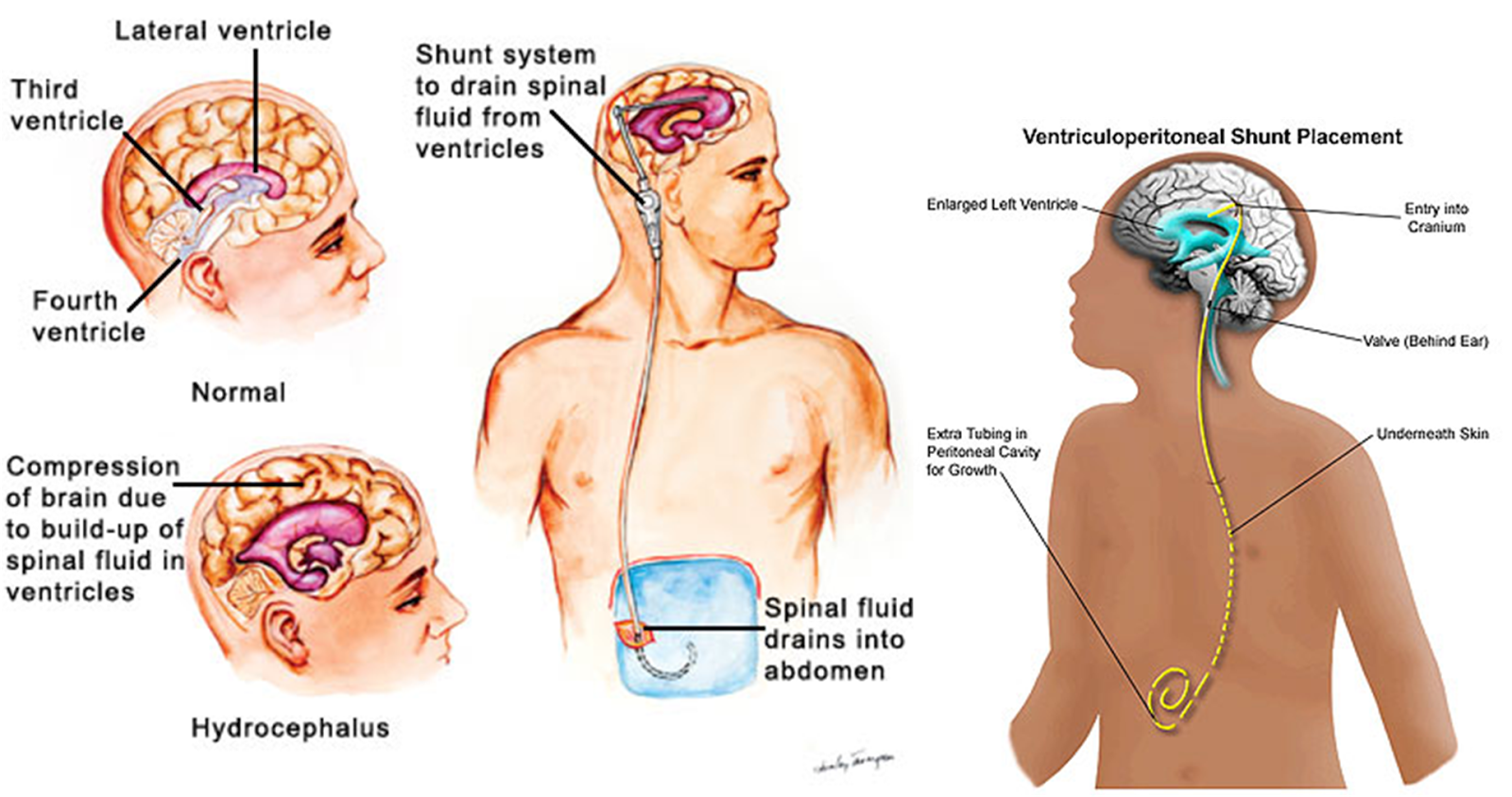
Cerebrospinal fluid is produced by the choroid plexus, in the ventricles of the brain. This fluid then travels all around your brain and spine and serves to, among other things, protect and cushion those structures. Hydrocephalus is when that fluid doesn’t reabsorb into the body, at which point it would then get reproduced, then reabsorbs, and so on. This cycle should happen 4x a day. With hydrocephalus, it gets produced as it should, but then just stays there in the ventricles. In younger infants, all that CSF can cause increased head circumference due to the skull not yet being one solid, hard piece. (Along with other serious complications including death. The bigger head is just the most obvious outward sign when you’re a baby.) In older kids and adults, the intracranial pressure placed on the brain from all that CSF can cause headaches, blurred vision, decreased mental capacity and other cognitive changes including a change in personality or demeanor, nausea, vomiting, fever, infection, and if not treated with a shunt, can cause death. I have what is called a VPL (ventriculo-pleural) shunt which is a catheter that is placed within one of the ventricles, connects to a one-way valve, and runs down my neck, resting above my lung, in the lining between my right lung and my ribcage, where CSF is drained and then absorbed by my body. Sometimes, these shunts break. Or get infected, or the holes meant to drain CSF get plugged up. That causes the shunt to fail. Then a shunt revision becomes necessary. The picture below shows a ventriculo-peritoneal (VP) shunt, which is a more common place for the shunt to drain.
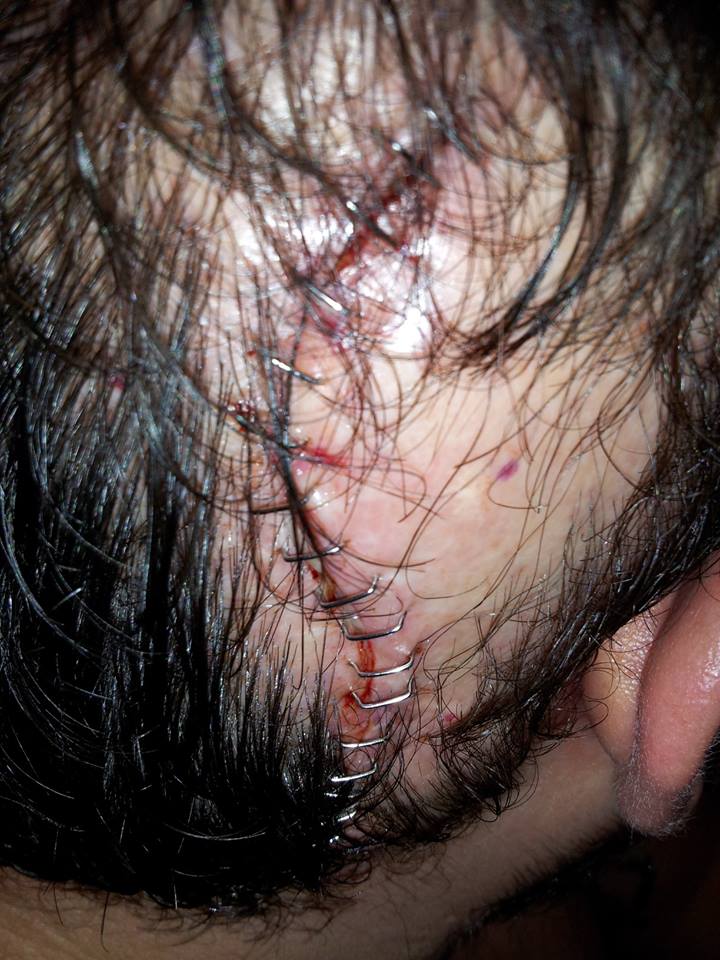
And this is my head after my last shunt revision in August 2013.
Hardcore, right? \m/(- -)\m/
3. Another condition that often accompanies Spina Bifida is called Arnold Chiari Malformation, or Chiari II. There are four different types of Chiari but if you are born with SB and also have Chiari, then you always have Chiari II. Part of the clinical definition is “consists of a downward displacement of the cerebellar tonsils through the foramen magnum (the opening at the base of the skull)”. Basically part of your cerebellum goes down into the top of your spinal column where it’s not supposed to be. Among other things, this stops CSF from flowing freely. Also, your cerebellum controls autonomic functions, which are things you can’t control consciously, such as breathing and swallowing and regulating body temperature. These autonomic functions are affected when you have Chiari II. Some symptoms are more severe than others. While some people end up with nothing more than a pretty bad gag reflex, for others it can be more serious and cause choking or severe breathing problems, sleep apnea or other sleeping disorders.
Here we have a typical brain and a Chiari brain. Note the herniated cerebellum, lower than it should be.
 Conveniently, what this picture also shows is a syrinx in the spinal column:
4. Syringomyelia. Or a syrinx. A syrinx is a fluid (CSF) filled bubble that forms in your spinal column. As previously mentioned, the spinal column has CSF running all through it. But within that, a cyst can also form, also filled with CSF. And it can be small or it can run the whole length of your spine. The length matters less than the width. If it’s too wide, it can crush spinal nerves and cause even more damage. In those cases, the neurosurgeon can try to drain it, although it may return, or she may place a shunt in your spine which should do the same thing it does in your brain; ie, continually drain CSF.
My syrinx is small, only at c7, and not obstructing CSF flow around it or crushing nerves. It was that size at an MRI in 1992 and that size at the MRI in 2013 and hopefully it will never get bigger.
5. Children with SB are often referred to as “million dollar babies” because of the estimated healthcare costs over a lifetime of care. (This source is calculated in 1980’s money, so it’s actually quite a bit more!)

6. Spina Bifida is the #1 permanently disabling birth defect in the United States. More people are affected by it (or would be….more on that in #7) than muscular dystrophy, multiple sclerosis, and cystic fibrosis *combined*. It’s also the most complex birth defect you could have and still survive. This is because it affects almost every part of your body and organs, either from the SB itself or from secondary or tertiary conditions. For example, one way your brain is affected is from the hydrocephalus, yes, but it can also be affected from the shunt surgeries that are meant to correct the hydrocephalus. Too many shunt surgeries can cause scarring on your brain which can lead to seizures. 40% of people with SB have some form of epilepsy. SB affects kidneys and can also have an effect on other internal organs for various reasons, including the fact that some of us have curvature of the spine, which can cause our lungs to not have enough room to adequately expand in our rib cages. So fact #6…..SB is not only the most common permanently disabling birth defect but is also the most complex in terms of body systems affected.
But if we are in fact #1, then how many of us are there? Well, rough estimates from various sources say there are currently 166,000 people in the US living with SB. I know what you’re thinking….”But wait….shouldn’t that number be higher?! If it affects more people than CF, MS and MD combined, shouldn’t there be more?!” Yep. Which brings me to SB Fact #7 and an explanation for why there aren’t more of us if we are ahead of those other more well-known conditions:


 My Bleeding Ink