Welcome To Holland (with a note at the end from yours truly)

Welcome To Holland
By Emily Perl Kingsley
I am often asked to describe the experience of raising a child with a disability – to try to help people who have not shared that unique experience to understand it, to imagine how it would feel. It’s like this……
When you’re going to have a baby, it’s like planning a fabulous vacation trip – to Italy. You buy a bunch of guide books and make your wonderful plans. The Coliseum. The Michelangelo David. The gondolas in Venice. You may learn some handy phrases in Italian. It’s all very exciting.
After months of eager anticipation, the day finally arrives. You pack your bags and off you go. Several hours later, the plane lands. The stewardess comes in and says, “Welcome to Holland.”
“Holland?!?” you say. “What do you mean Holland?? I signed up for Italy! I’m supposed to be in Italy. All my life I’ve dreamed of going to Italy.”
But there’s been a change in the flight plan. They’ve landed in Holland and there you must stay.
The important thing is that they haven’t taken you to a horrible, disgusting, filthy place, full of pestilence, famine and disease. It’s just a different place.
So you must go out and buy new guide books. And you must learn a whole new language. And you will meet a whole new group of people you would never have met.
It’s just a different place. It’s slower-paced than Italy, less flashy than Italy. But after you’ve been there for a while and you catch your breath, you look around…. and you begin to notice that Holland has windmills….and Holland has tulips. Holland even has Rembrandts.
But everyone you know is busy coming and going from Italy… and they’re all bragging about what a wonderful time they had there. And for the rest of your life, you will say “Yes, that’s where I was supposed to go. That’s what I had planned.”
And the pain of that will never, ever, ever, ever go away… because the loss of that dream is a very very significant loss.But… if you spend your life mourning the fact that you didn’t get to Italy, you may never be free to enjoy the very special, the very lovely things … about Holland.©1987 by Emily Perl Kingsley. All rights reserved.
EPKingsley@aol.com

___________________________________________

So…..some people don’t like this story.  Particularly some parents of newborns with special needs.  Not all parents.  But some.  And I can understand that.  As a 30 something year old man with SB, I have a different perspective now with the hindsight of Life Experience, but I can understand those parents point of view.  They are going through a very difficult time with their little one.  I can imagine.  Your kid is 6 months old, has already had surgery after surgery, endless nights in the hospital, complications left and right….they’re thinking “fuck Holland!”  They love their kid, but man…fuck Holland.  “I wanted to go to Italy.  Why aren’t I in Italy?”  They love their kids more than life itself…..but they do get tired of the hospital.  And they read this story and some parents get a little pissed.  They say this story is just telling them to be “happy happy happy” all the time, always, all day, all the time.  To just suck it the hell up and be thankful for your child and just be happy.  Don’t be angry.  Don’t have moments of “why me?”  Don’t be negative in any way.

And sometimes you can’t do that.  When your kid is 2 and can’t tell you his shunt might be broken…..fuck Holland.  When he is 6 and 7 and 8 years old, and can’t do the things other kids do, and kids make fun of him….fuck Holland.  Even as he gets older and misses some high school due to surgeries, and all you wanted was Italy.  At this point, not for yourself, but for him.  Fuck Holland.

But I don’t think that’s what this story says, and I don’t think you need to be happy all the time.  Have your “why me, why my son, why my daughter” moments.  Life is tough with a child with special needs.  Hell, from what I know, life is tough with a baby, period!  The late nights, the crying, no sleep, ear infections.  It’s tough with a baby.  Let alone a child with special needs.  I remember what I went through as a kid!  The surgeries, the ER trips, the complications, the pain….can’t imagine what it was like for my mom and dad to watch me go through it!
So….no….I don’t think this story is saying that it’s easy, or that you need to be happy all the time.

Here’s what I do know tho…..35+ years after being born with the most complex birth defect you could have and still survive, after everything I’ve been through….I would still very much rather be alive than not alive!  Not that Life is easy, not that this summer’s surgeries didn’t mess with me and continue to mess with me and my head.  Stress and anxiety have been through the roof some days.  It’ ain’t always pretty.  But I’d still rather be here than not. Life doesn’t suck.  All in all, life doesn’t suck.  I’m remarried, hell even my previous marriage gave me great memories and experiences, and now I’m with a great woman who fits better in my Life Puzzle, I have a handful of close friends who would do anything for me and I for them.  Life has it’s struggles and it’s ups and downs, but man, it’s still good to wake up every morning and be alive.

I like living. I have sometimes been wildly, despairingly, acutely miserable, racked with sorrow, but through it all I still know quite certainly that just to be alive is a grand thing.

~English mystery writer Agatha Christie

Thank you to my mommy who didn’t know she would be having a child with SB, not in the mid 70’s, and thank you to all the mommies out there who chose to have their kids when given the prenatal diagnosis, as I’m sure many of you were.
And now, 35+ years after I was born, I’d like to share with you what happened when my own mom first read this story, about 10 years ago.  She started crying.  A lot.  And through the tears, she said, “I would never give up my Holland. For 1000 Italy’s, I never would’ve given up my Holland. He grew up and while he will always be my son, he also became one of my best friends.”

All together now: “Awwwwwwww” ❤

The other thing she said it did tho, was make her stronger.  She is one of the strongest people I know.  And she said that it was because of me.  Because having a child with special needs, and having to be so strong for him when he was in surgeries or the hospital at 6 and 7 and 8 and 9 (and 19 and 20 and 21 and 37) made her better able to handle pretty much anything.  She said it gave her the backbone some other people just don’t have.  Having to be the advocate when I was too young to advocate for myself, having to stand up to doctors who wanted to do something crazy that she didn’t agree with, having to be strong for me when I was just terrified.  She talked about how whenever life hits her with other issues and other problems, she would think to herself “Ha! That’s it?!  My son has almost died like half a dozen times, and this is all you got now?! Bring it!”

so….moms….dads….you don’t always have to be happy, you can break down and lose it whenever you want….I don’t think Welcome to Holland tells you not to.  But just know that eventually, your kid will grow up and be a 37 year old sometimes pain in your ass O:)  who made you a strong person, better able to handle anything.  And at 37, hopefully a pretty good friend to you. ❤
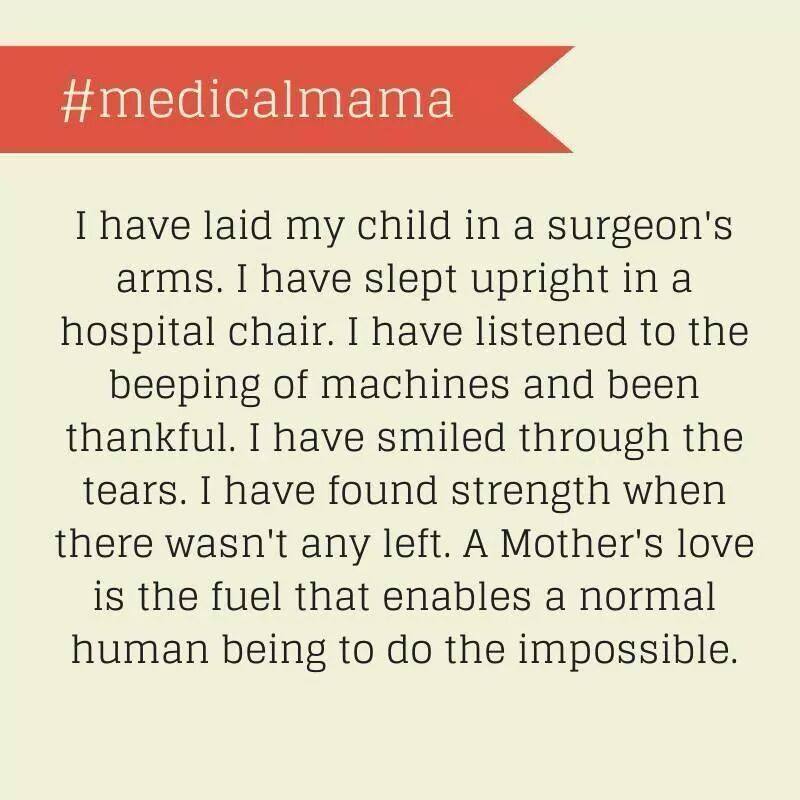
i have held my child

I like Welcome To Holland…..

Posted in Disability Advocacy | Tagged , , , , , , , | 1 Comment

Credo for Support

Credo for Support

Do not see my disability as a problem. Recognize that my disability is an attribute.
Do not see my disability as a deficit. It is you who see me as deviant and helpless.
Do not try to fix me because I am not broken. Support me. I can make my contribution to the community in my way.
Do not see me as your client. I am your fellow citizen. See me as your neighbor. Remember, none of us can be self-sufficient.
Do not try to modify my behavior. Be still and listen. What you define as inappropriate may be my attempt to communicate with you in the only way I can.
Do not try to change me, you have no right. Help me learn what I want to know.
Do not hide your uncertainty behind “professional” distance. Be a person who listens and does not take my struggle away from me by trying to make it all better.
Do not use theories and strategies on me. Be with me. And when we struggle with each other, let me give that rise to self-reflection.
Do not try to control me. I have a right to my power as a person. What you call non-compliance or manipulation may actually be the only way I can exert control over my life.
Do not teach me to be obedient, submissive, and polite. I need to feel entitled to say no if I am to protect myself.
Do not be charitable to me. The last thing the world needs is another Jerry Lewis. Be my ally against those who exploit me for their own gratification..
Do not try to be my friend. I deserve more than that. Get to know me. We may become friends.
Do not help me even if it does make you feel good. Ask me if I need your help. Let me show you how to better assist me.
Do not admire me. A desire to live a full life does not warrant adoration. Respect me, for respect presumes equity.
Do not try to control my decision-making, this is my life-let me decide what I want to do with it.
Do not tell, correct and lead. Listen, support and follow.
Do not work on me. Work with me.

Posted in Disability Advocacy | Tagged , , , , , | Leave a comment

Disability Etiquette

This comes from the United Spinal Association and emphasizes the importance of etiquette (disability specific).

1. Ask before you help. :Offer assistance if you notice a need but ask first if your help is necessary. Offer common courtesies, such as holding doors open, picking something up, helping to carry things to people with disabilities as you would anyone.
Good manners are appreciated by everyone.

2. Be sensitive about an individuals’ physical space: Moving a person’s medical equipment without asking may create negative feelings. Consider the medical equipment to be personal space. Also, be aware of the height difference for people in wheelchairs. It is difficult to always look up at someone who is talking. Pay attention to your proximity to person in a wheelchair when you are in a line. Never ask a person in a wheelchair to carry such things as your coat on his or her lap.

3. Always speak directly to the person with the disability: Speak to people with a disability as you would to anyone. Avoid talking to them through their companions, interpreters or aides. Speaking directly to people with a disability is important for their self-esteem. If an individual has a companion dog, be sure to talk to the owner first before approaching the dog. The dog is working and has a responsibility to assist its owner. Misdirected attention can, over time, break down the dog’s training.

4. Don’t ask unnecessary personal questions: Don’t ask what happened unless there is a professional need to know. Imagine if you had to tell people repeatedly about the worst day of your life. An exception may be children who have a natural curiosity. Most people who have disabilities do not mind answering personal questions from children.

5. Don’t make assumptions: People with disabilities can best decide what they are capable of doing. You could violate ADA rules if you exclude people based on presuming their limitations.

6. Be kind in considering special requests: Do your best to accommodate a person with a disability. A request for an accommodation for a disability is not a complaint, so don’t take it personally.

7. Put the person first: Everyone wants to be valued as a person first and foremost. When communicating, always say person with disability rather than disabled person. Avoid outdated terminology such as handicapped or crippled.  Avoid negative terms such as victim or sufferer.

Remember, people with disabilities are individuals just like you. While they may agree that a disability plays an integral part in their lives; it does not define them.  Treat all people with respect and kindness, regardless of their abilities or disabilities.

Source: United Spinal Association publication

Posted in Disability Advocacy | Tagged , , , , , , | Leave a comment